
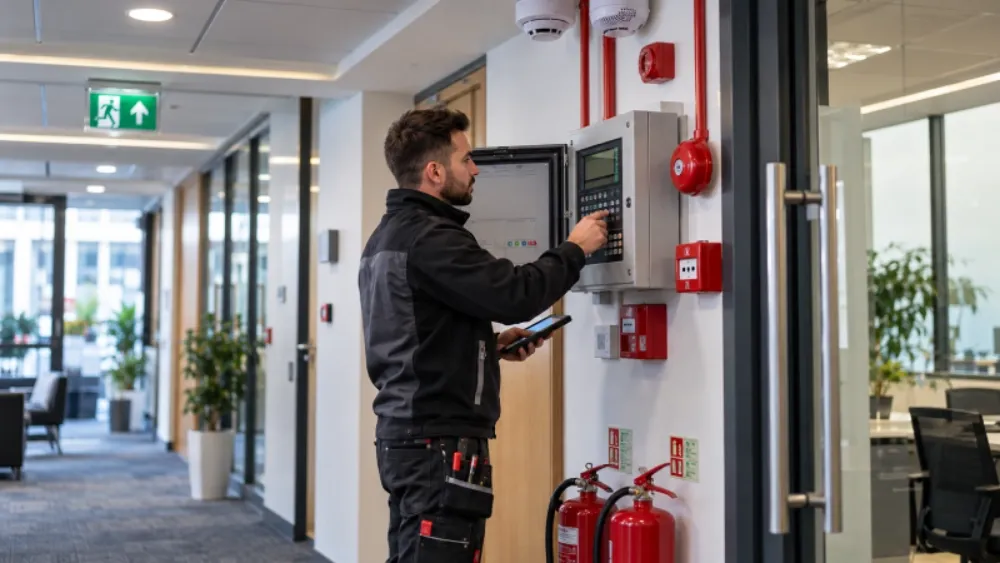
Consider that a fire starts in a commercial building at 3 am, and the smoke begins spreading through a corridor. A detector will be able to identify it and the control panel should receive the signal. Further the alarm should activate, and the people are warned.
But what if one of those stages fails? That is exactly why installing a fire alarm is only the beginning of fire protection.
A commercial fire alarm system needs to be tested and maintained regularly, so that faults can be identified before an emergency puts the system to the test. In Greater Manchester, the Fire and Rescue Service states that businesses with fire alarm systems should test them every week, while government guidance recommends periodic servicing and preventive maintenance by a competent person. For businesses who are arranging fire alarm installation Manchester, then this is an important point to understand from day one. The system needs to remain in effective working order throughout its life.
A Fire Alarm is a System, Not a Single Device
It is easy to think of a fire alarm as a collection of smoke detectors hanging from the ceiling. However, in reality, a commercial fire alarm system can include smoke and heat detectors, manual call points, alarm sounders, visual alarm devices, control and indicating equipment, batteries and backup power, interfaces with other building systems, monitoring connections, and wiring and communication infrastructure
Every part has a role like a detector needs to detect, the control panel needs to receive and process the signal, the warning devices need to alert people, and the connected equipment may need to respond appropriately. If one part develops a fault, then the overall performance of the system can be affected. With regular testing, one can check that these different elements continue to work together.
Testing Helps Find Problems before an Emergency
This is the most obvious reason to test a fire alarm, but it is also the most important. A fault might not produce an obvious warning to everyone in the building, so a damaged component, wiring issue, battery problem or faulty detector could remain unnoticed until the system is needed.
With weekly testing, one can create a regular opportunity to identify problems. It is advised that businesses should test their fire alarm systems weekly, with a different manual call point that can be used each week where the red break-glass call points are installed. If a business repeatedly tests the same call point, then it does not provide the same level of assurance across the entire system.
Regular Testing Confirms the Alarm Can Actually Be Heard
Detecting a fire is only part of the job as people need to know that there is a fire. A commercial building may have multiple floors, enclosed rooms, noisy working areas, plant rooms, storage spaces or areas that are rarely occupied.
A fire alarm needs to provide an appropriate warning throughout the premises. It is recommended that weekly testing of fire-detection and warning systems and notes along with additional tests may sometimes be necessary, so that the staff working outside normal hours have the opportunity to hear the alarm.
This is particularly relevant to businesses operating during the night shifts, early morning shifts, and weekend schedules, rotating staff patterns, large warehouses, hospitality venues and multi-floor offices. A system can technically activate while still failing to provide an effective warning in every area. With testing, you can help businesses to identify that problem.
It Helps Identify Faults on the Control Panel
The control panel is effectively the brain of many commercial fire alarm systems. It receives information from detection devices and displays faults or system conditions. With regular checks, one can reveal warning indicators that might otherwise be overlooked.
By maintaining fire safety systems in effective working order and keeping records of inspections, testing and maintenance, a business will have a clear process for checking the panel and dealing with reported faults rather than simply assuming that a quiet panel means everything is perfect. A fault indicator is not something to ignore because the alarm still works, rather it is a signal that something needs attention.
Testing Can Help Reduce False Alarms
False alarms create a different problem. If a fire alarm activates repeatedly, then without a genuine fire, the systems will become less responsive.
The alarm becomes background noise rather than an urgent warning. The false alarms are an issue and so businesses need to investigate the causes and ensure systems are properly designed, installed and maintained by a competent fire alarm engineer. With regular testing and professional servicing can help identify issues contributing to unwanted activations. For instance, the problems may relate to detector contamination, environmental conditions, incorrect detector selection, damaged equipment, system faults, poor maintenance, and changes within the building. The objective isn't simply to make the alarm louder. It is to make sure that the system provides a reliable warning when a genuine fire occurs while reducing unnecessary activations.
Your Building May Have Changed Since Installation
This is an often-overlooked reason for regular review. A commercial property rarely stays exactly the same for years as businesses change their office layouts,storage arrangements, machinery, working hours, occupancy levels, internal partitions, lighting, heating and ventilation and even the Business activities.
1. A detector that was correctly positioned five years ago may no longer provide the same level of coverage after a major refurbishment.
2. A storage area might become an office.
3. An office might become a kitchen.
4. A new partition might alter how smoke travels through an area.
This is why Fire alarm maintenance should be considered alongside the wider fire-risk assessment rather than as an isolated technical task. The responsible person must ensure that the fire-risk assessment remains up to date and that the fire-safety arrangements, including alarm testing and maintenance are recorded.Weekly Testing and Professional Servicing Are Not the Same Thing
This distinction is important as a weekly test does not replace professional servicing. Weekly testing is generally a routine check that is carried out as part of the building's fire-safety arrangements. With periodic servicing, a more detailed inspection and maintenance process is performed by a competent person.
All types of fire-warning systems should be tested weekly and that six-monthly servicing and preventive maintenance should be carried out by a competent person with specialist knowledge of fire-warning and automatic detection systems. So, the businesses should think about fire alarm maintenance as two connected layers of routine testing and professional servicing as both have a role.
What Should a Commercial Fire Alarm Testing Routine Look Like?
The exact arrangement should follow the property's fire-risk assessment, system design, manufacturer instructions and applicable guidance. Therefore, a typical framework can include daily or routine visual check
1.Weekly alarm tests can be performed using a manual call point so that different parts of the system are checked over time.
2. Periodic professional servicing is also a good practice, as the system can be inspected and serviced by a competent fire alarm professional at the appropriate interval.
3.Non-routine checks may be necessary, especially after events such as a fire, significant fault, system modification, or other circumstances affecting the system.
Such an exact testing regime should always be based on the premises and applicable requirements rather than blindly following a generic calendar. A fire alarm can only protect people if it is capable of doing its job when required. With regular testing, routine weekly testing, appropriate professional servicing, accurate records and prompt fault resolution creates a much stronger fire-safety management process.
Need Fire Alarm Testing or Servicing in Manchester?
If your business needs a new system, an inspection of an existing installation or ongoing fire alarm servicing Manchester region, then make sure you choose a competent provider that can support the system beyond the initial installation.
About Secure MCR
Secure MCR is a trusted security installation company in Manchester, protecting homes and securing businesses across Greater Manchester and the surrounding areas. From the first design to ongoing maintenance, our team helps keep your property safe, compliant and protected.
Our services include:
Fire Alarm Installation & Servicing: installation, testing and regular maintenance for commercial buildings
CCTV Installation & Maintenance
Intruder Alarm Systems
Access Control & Door Entry Systems
Electrical Installation
Emergency & Security Lighting
Bollards, Barriers & Security Gates
Whether you need a new fire alarm system or a routine service for an existing one, Secure MCR can support your property beyond the initial installation.
Book a Consultation or call us on +44 7514 856229 to speak with our team.