
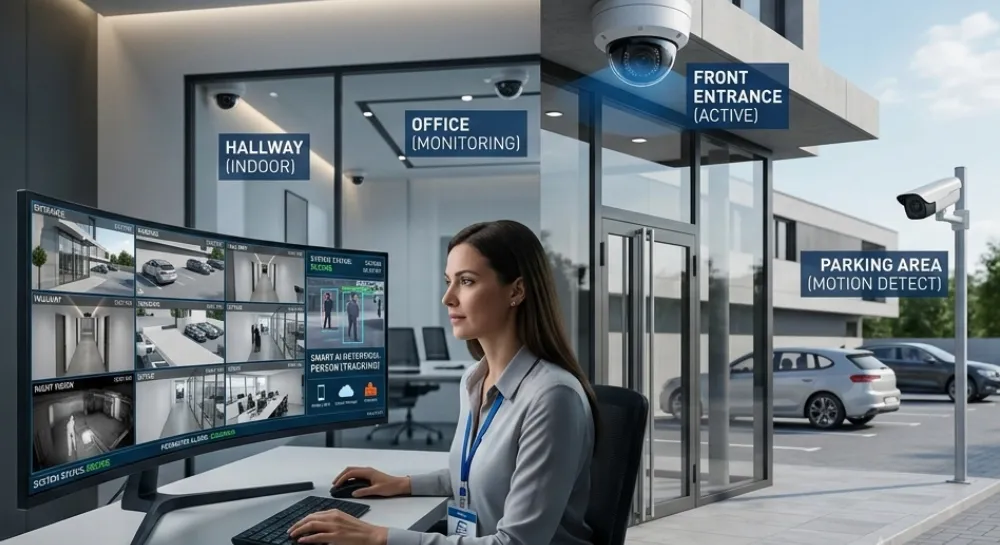
A CCTV camera can be one of the most visible parts of a security system, but the camera itself is only half the story. Where it is installed can determine what it actually captures. A high-resolution camera pointed at the wrong area may produce hours of footage without showing the one detail that matters. On the while a carefully positioned camera can monitor an entrance, identify movement, reduce blind spots, and provide useful evidence when an incident occurs.
This is why professional CCTV installation services focus on camera placement as much as equipment selection. Whether you are protecting a home, shop, office, warehouse, car park, or industrial property, knowing where CCTV cameras should be installed is essential for creating a security system that watches the areas that matter most.
Why CCTV Camera Placement Matters?
Installing more cameras does not automatically mean better security. Here, a poorly positioned camera can be affected by:
1. Blind spots
2. Direct sunlight
3. Glare
4. Poor lighting
5. Obstructions
6. Incorrect viewing angles
7. Excessive distance from the subject
With professional CCTV camera installation Manchester providers, you can assess the property first and then determine where the cameras can deliver the most useful coverage. The objective of the installer is simple, to have maximum useful coverage with minimum unnecessary overlap.
Main Entrance and Front Door
The primary entrance should almost always be one of the first locations considered for CCTV. This is where:
1. Customers enter
2. Employees arrive
3. Visitors approach
4. Deliveries may be received
5. Unauthorized individuals may attempt access
A camera positioned here can provide useful footage of people approaching and entering the building. However, by simply placing a camera high above the door isn't always ideal. The camera should be positioned, so that faces and other important details can be captured clearly rather than viewing people from an extreme overhead angle.
Rear and Side Entrances
Businesses sometimes focus heavily on the front entrance and forget about less visible access points. The rear and side doors can be particularly important because they may have:
1. Less pedestrian activity
2. Limited lighting
3. Fewer people watching them
4. Easier access to storage or service areas
These entrances should be assessed individually during a professional site survey. For the commercial premises, then the coverage of staff-only entrances can also help monitor movement outside normal operating hours.
Driveways and Vehicle Access Points
For homes, offices, warehouses, and industrial premises, vehicle access points are another important CCTV location. Here, the cameras can monitor:
1. Driveways
2. Gates
3. Vehicle entrances
4. Delivery areas
5. Loading zones
If identifying vehicles or number plates then it is important, the camera should be selected and positioned specifically for that purpose. A wide-angle camera placed too far away may show that a vehicle entered the property but fail to capture enough detail to identify it.
Car Parks
Car parks can contain several security risks, especially outside normal working hours. Here, the CCTV coverage can help monitor:
1. Vehicle movement
2. Pedestrian activity
3. Entry and exit routes
4. Suspicious behaviour
5. Damage or theft incidents
Large car parks may require multiple cameras with overlapping views. However, simply adding cameras around the perimeter isn't enough. The viewing direction, lighting, height, and distance from important areas should all be considered.
Building Perimeters
The outer boundary of a property can provide valuable early-warning coverage. The cameras can be positioned to monitor:
1. Fences
2. Gates
3. Side passages
4. Rear boundaries
5. Access roads
For larger commercial or industrial properties, then the perimeter cameras can help detect movement before someone reaches the main building. With AI-enabled cameras, then it can be configured to detect people or vehicles entering defined areas, depending on the capabilities of the system.
Blind Spots around Corners
Corners are among the easiest areas to overlook. While a building may have excellent coverage at the front, but it leaves the sides or rear almost completely invisible. During CCTV installation, the professionals should walk around the entire property and identify locations where someone could approach without being visible to existing cameras. This is particularly important around:
1. Building corners
2. Narrow passages
3. Rear extensions
4. External storage
5. Garages
6. Side gates
A security system should be designed from the perspective of how someone could approach the property, not just simply from where the cameras are easiest to mount.
Reception and Customer Areas
For offices, hotels, clinics, shops, and other customer facing businesses, then the reception areas can benefit from CCTV coverage. A camera can help monitor the following spaces:
1. Entry and exit activity
2. Customer movement
3. Reception desks
4. Visitor interactions
However, businesses should carefully consider privacy when they are deciding on what areas to record. The Information Commissioner's Office (ICO) states that the organizations using CCTV should consider whether surveillance is necessary and proportionate, and should respect people's privacy.
Cash Registers and Payment Areas
Retail businesses may consider CCTV coverage around:
1. Cash registers
2. Checkout counters
3. Payment points
4. Cash offices
These are the areas that may require particularly careful camera positioning. The objective is to capture useful activity without unnecessarily recording sensitive information such as PIN entry screens or private customer details. A professional installer can adjust the camera angle and field of view to balance security with privacy.
Stockrooms and Warehouses
Stockrooms can contain valuable inventory and may not be constantly occupied. So, the CCTV can be positioned to monitor:
1. Stockroom entrances
2. High-value inventory
3. Warehouse aisles
4. Loading areas
5. Goods-in and goods-out points
In large warehouses, the camera selection becomes particularly important. So, a wide area may require cameras that are capable of covering larger distances, while the entrances may need more detailed views.
Loading Bays and Delivery Areas
Businesses receiving regular deliveries should consider CCTV around loading zones. These are the areas can experience frequent movement involving:
1. Employees
2. Drivers
3. Contractors
4. Vehicles
5. Deliveries
A well-positioned camera can help establish what happened if stock is damaged, a delivery is disputed, or an unauthorized vehicle enters the area. For the busy commercial premises, then you must combine CCTV with access control that can provide even greater visibility.
Staircases and Internal Corridors
In a property, the internal movement can sometimes be overlooked when planning to install CCTV. So, depending on the property and security objectives, the cameras to be positioned may be appropriate around:
1. Main corridors
2. Staircases
3. Restricted passages
4. Elevator entrances
5. Access routes to sensitive rooms
The purpose here should be clearly defined rather than simply recording every possible area.
Server Rooms and High-Security Areas
Some rooms require stronger monitoring than ordinary office spaces. These may include the following:
1. Server rooms
2. Equipment rooms
3. Cash storage
4. Pharmaceutical storage
5. Sensitive document areas
With CCTV, you can have an additional layer of protection alongside access control. If someone enters a restricted area, then the camera footage can help establish what happened and when.
Garden, Garage, and Rear Areas
Residential properties can have security weaknesses away from the front door. So, the important locations to install CCTV may be included here are:
1. Garages
2. Garden gates
3. Rear gardens
4. Sheds
5. Side passages
6. Driveways
A camera covering the front of the house cannot protect areas it cannot see. For the homes with larger outdoor spaces, then having multiple cameras may be necessary to eliminate significant blind spots.
Areas with Poor Lighting
A camera's location isn't the only consideration. So, the lighting can dramatically affect the usefulness of footage. Here, the cameras should be installed that are facing:
1. Bright security lights
2. Headlights
3. Direct sunlight
4. Reflective surfaces
At night, the infrared illumination can also reflect from nearby surfaces and reduce image quality. With professional CCTV camera installation services, the camera placement is perfectly assessed during both daytime and night time conditions.
Why Professional CCTV Installation Matters?
A camera installation shouldn't be approached as simply. As the professional CCTV installers consider the property as one complete security environment. Here, they assess:
1. Vulnerable access points
2. Camera angles
3. Blind spots
4. Lighting
5. Cable routes
6. Network connectivity
7. Recording requirements
8. Future expansion
The best CCTV system isn't necessarily the one with the largest number of cameras. It is the one where every camera has a clear purpose and contributes to the overall security strategy.
For homeowners and businesses considering CCTV installation Manchester services, a professional planning can help turn individual cameras into a complete surveillance system. The experienced CCTV camera installation Manchester providers will assess the property, identify vulnerable areas, select suitable camera types, and position them for useful coverage rather than simply maximum quantity.
Why Choose Secure MCR for Professional CCTV Installation in Manchester?
At Secure MCR, we provide professional CCTV installation in Manchester for homeowners, businesses, retail stores, offices, warehouses, schools, and industrial properties. Our experienced security engineers or security installers in Manchester design every CCTV system to suit your property's layout, ensuring maximum coverage of entrances, exits, driveways, car parks, and other vulnerable areas.
As a trusted security installation company in Manchester, we don't simply install cameras, we carry out a detailed site survey, identify potential security risks, recommend the most suitable CCTV cameras, and position them strategically to reduce blind spots while complying with current UK privacy guidelines.